

 Contact us
 Visit CPRE.org
 Donate
Polytunnels
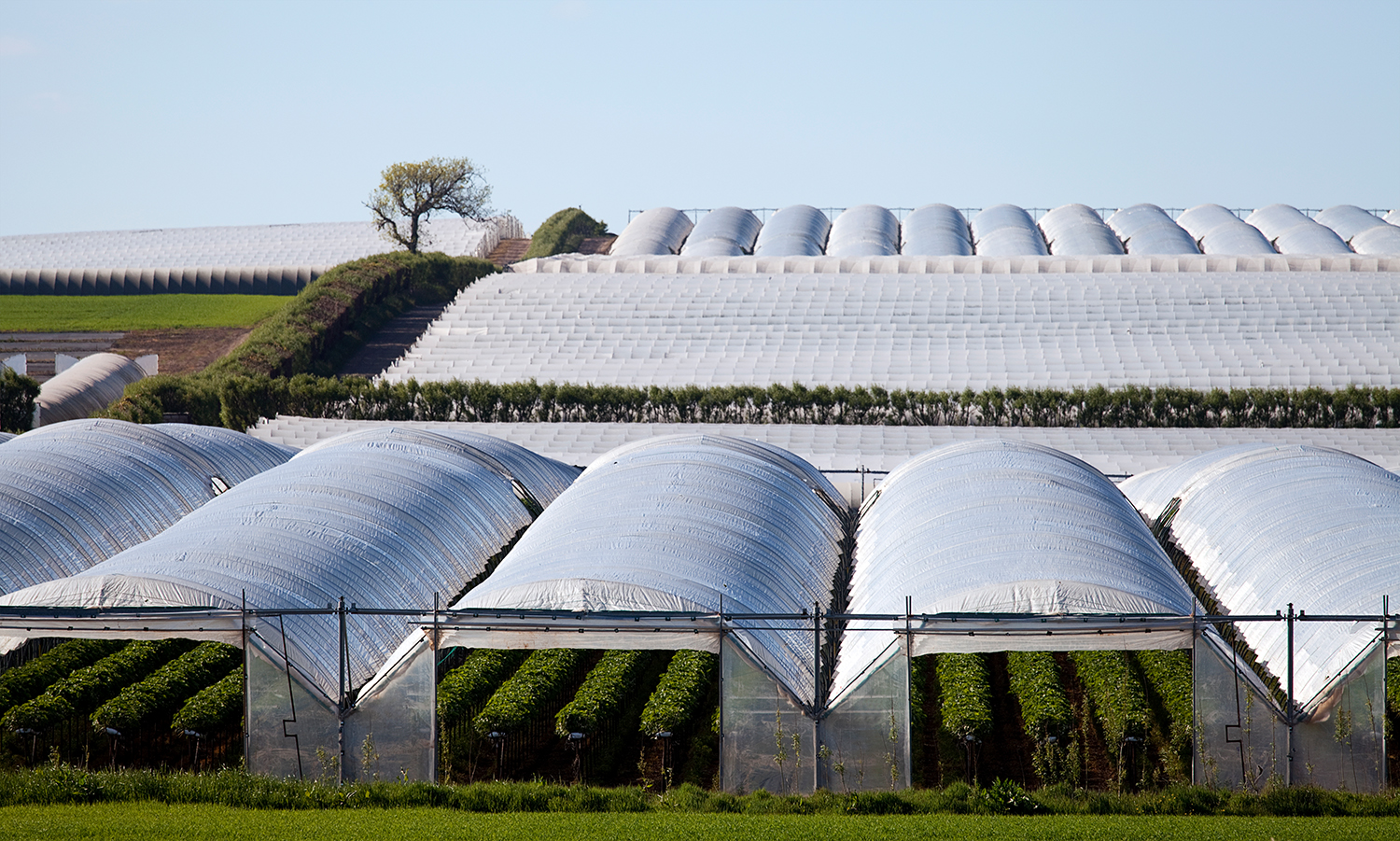
Polytunnels can cover large areas of land, and their white, reflective plastic can spoil views across the landscape. Here we look at the potential damaging impacts of large-scale polytunnel developments on the Herefordshire countryside.
There are already several large polytunnel developments in Herefordshire. These structures can be intrusive and can have a cumulative, damaging effect on the landscape. Section 3 of the Herefordshire Council Polytunnels Planning Guide 2018 illustrates many of the issues that can arise.
Polytunnels planning guidelines
When deciding whether to comment on a planning application for polytunnels for intensive soft fruit growing, think first about their scale and location. Large developments usually have linked tunnels (“Spanish polytunnels”), and most are effectively permanent. The fruit is grown in raised structures with fixed irrigation and feeding systems, so the polytunnels will be visible for years to come. Where cherries are grown intensively, the polytunnels are taller and the trees are planted in the ground, but irrigation piping is still installed.
With all types of polytunnel, excess run-off is a potential problem, particularly near rivers and streams that flow into the River Wye Special Area of Conservation.
Look closely at the documents submitted with the application and check:
- whether the polythene covers will be removed for a fixed period during the winter
- whether an Environmental Impact Assessment (EIA) was required, and if so, whether the report is on the council’s website
- whether an EIA scoping opinion was required, and if so, whether it is on the website
- whether a Habitats Regulations Assessment was needed, and if so, whether it is on the website
- how the development will deliver the required biodiversity net gain of at least 10% (GOV.UK)
Other planning considerations include:
- how close the site is to a protected landscape, such as a National Landscape (formerly Area of Outstanding Natural Beauty), or to a nature reserve
- the distance from any watercourse (very important)
- views from public rights of way and public roads
- views to and from listed buildings and archaeological sites
- the potential effects on nearby homes and residents
Look out for all the associated developments too, including seasonal workers’ accommodation, pods, toilet blocks, recreational facilities, irrigation, drainage and sewage disposal works, and road access.
When writing to the planning officer, always quote the relevant planning policies. These are:
- the National Planning Policy Framework (August 2026), especially Chapter 19 “Conserving and enhancing the natural environment” (policies N1 to N6) and policy S5 on development outside settlements
- the Herefordshire Local Plan Core Strategy 2011–2031, policies SS6, RA3, RA6, LD1, LD2, LD3, SD3, SD4 and MT1. The council is preparing a new Local Plan for 2025–2045, but the Core Strategy remains in force until it is adopted.
- the management plan for the relevant National Landscape, such as the Wye Valley or Malvern Hills
- the Herefordshire Council Polytunnels Planning Guide (June 2018)
If you need advice, please contact us and we’ll do our best to help.
Try to submit your comments before the end of the public consultation period. You can still send comments to the planning officer up to the date the decision is made.