

 Contact us
 Visit CPRE.org
 Donate
We propose two new National Landscapes for Herefordshire

Herefordshire is a largely agricultural county with stunning landscapes and areas rich in wildlife. Yet only two small parts of the county are protected as National Landscapes (formerly Areas of Outstanding Natural Beauty), and both are shared with neighbouring counties: the Malvern Hills and the lower Wye Valley. Here we explore the history behind this, and why we are calling for our precious western uplands to be protected as a National Landscape.
The back story
After the Second World War, the 1947 Hobhouse Report identified areas across England and Wales for protection as National Parks or Areas of Outstanding Natural Beauty (AONBs). Following the National Parks and Access to the Countryside Act 1949, the new National Parks Commission considered which areas to designate. According to our research, these included the Radnor Forest and Black Mountains, as part of a Clun and Radnor Forest AONB and the Brecon Beacons National Park (now Bannau Brycheiniog) respectively. In both cases, plans to include parts of Herefordshire were dropped because of the “administrative complications” of designations crossing the border between England and Wales.
In 2012 we published the report A New AONB for the Marches? Exploring the case for more Areas of Outstanding Natural Beauty. It focused on the areas of west Herefordshire that had been earmarked for protection but never designated.
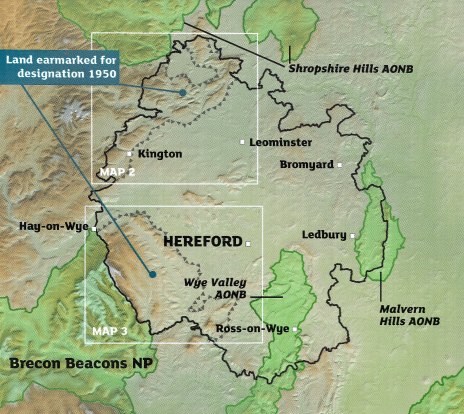
In 2013 we formally submitted the report to Natural England, with the support of Herefordshire Council. Natural England had just started a new programme to review new or extended designations and included our proposal. Soon afterwards, however, it suspended the programme to concentrate on a large backlog of boundary changes.
At a standstill?
The government’s 2019 Landscapes Review (the Glover Review) listed a new Herefordshire Marches AONB among the proposals put forward for our region (Wye Valley AONB Joint Advisory Committee, 2022). Natural England has since commissioned an all-England strategic landscape assessment, intended as a modern update of the 1947 Hobhouse map, to identify areas that could be designated in future.
But progress remains slow. Natural England’s designations programme, last updated in July 2026, lists just four landscape projects: the Yorkshire Wolds, the Cheshire Sandstone Ridge, and extensions to the Surrey Hills and Chilterns. Herefordshire is not among them. In June 2025 Natural England halted work on the Chilterns extension, saying limited funding meant it had to make “hard choices” about which projects to continue (CPRE Hertfordshire).
We fear that proposals like ours are stuck in a stalled programme. There is a real danger of a planning “dead zone” along the Wales–England border, because of the bureaucratic difficulties of designating areas that cross the boundary. Meanwhile, Wales is moving ahead: Natural Resources Wales has backed a new Glyndŵr National Park in north-east Wales, and the Welsh Government has announced a public inquiry into the proposal (CPRW, 16 October 2026).
The aim of designation is that community and business life can continue, change and grow while a beautiful landscape and its wildlife are protected. Designating the two areas in west Herefordshire would also improve habitat connectivity, by linking larger protected areas across the border. We continue to call for our lovely western uplands to be designated.