

 Contact us
 Visit CPRE.org
 Donate
Thank You, Nicola: 10 Years Protecting Herefordshire’s Countryside
10 Years as a CPRE Herefordshire trustee and PLAN team member

Intensive chicken farming is highlighting the tension between cheap food and a safe and healthy environment.
In Herefordshire large corporations are driving the production of cheap food on an industrial scale. The increasing number of giant chicken sheds is having a big impact on the quality of life for local people, soil and water pollution levels and animal welfare.
There’s an estimated minimum 20 million plus chickens being farmed in Herefordshire right now – that’s over 100 for every adult and child in the county (Rivercide TV). These are either farmed for eggs or their meat (broiler chickens). These numbers are increasing all the time and are driven by big businesses.
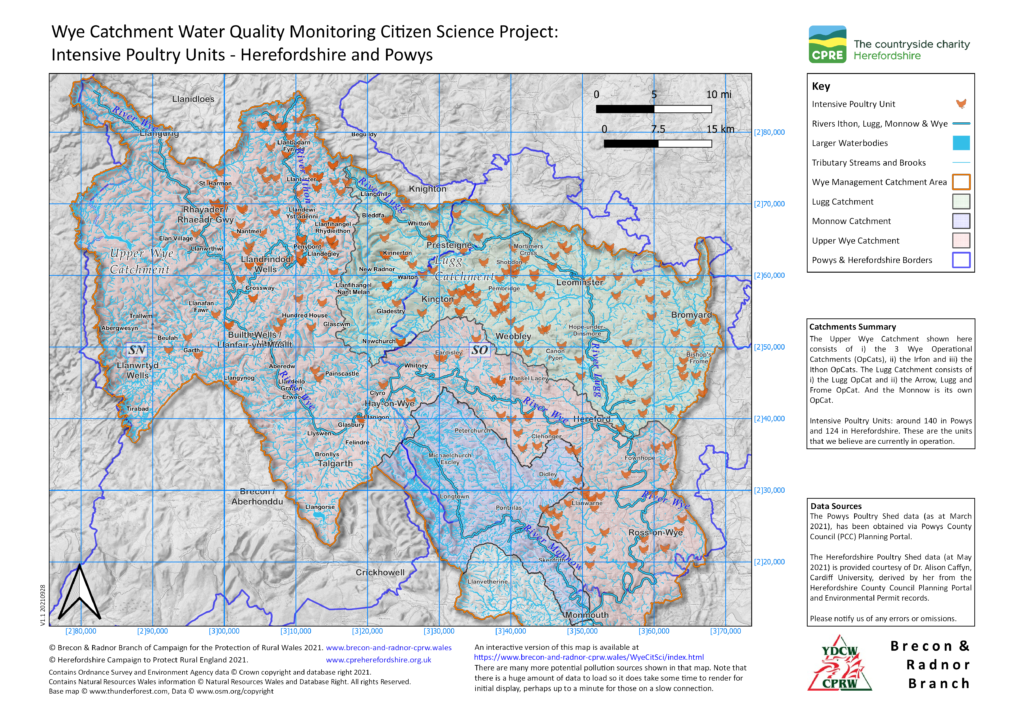
We’ve teamed up with the Brecon and Radnor branch of our sister organisation CPRW to produce an interactive map showing the density of chicken units in the Wye catchment area. (It may take some time to load up as there’s a lot of data!)
The reality of modern egg and chicken production is a long way from traditional images of a few hens pecking around the farmyard. Avara Foods, a joint venture between the US-owned global agribusiness Cargill and the British company Faccenda Foods, runs a hatchery at Shobdon in north Herefordshire, a chicken processing plant in Hereford and a feed mill at Tram Inn, Allensmore. Local farmers own the huge chicken sheds and raise the birds for Avara, which collects them when they are fully grown. The chickens are fed largely on soya imported from Brazil. Much of it is traded by Cargill and grown in the Cerrado, a highly biodiverse tropical savanna, where suppliers’ farms have been linked to around 800 sq km of deforestation since 2015 (Bureau of Investigative Journalism and The Guardian, 25 November 2020).
Intensive poultry units (IPU) are regulated as industrial operations. The Environment Agency requires an environmental permit for any poultry farm with more than 40,000 birds (GOV.UK). Any development housing more than 85,000 broilers or 60,000 laying hens falls within Schedule 1 of the Town and Country Planning (Environmental Impact Assessment) Regulations 2017. This puts it alongside major airports and nuclear power stations, and means a full Environmental Impact Assessment is always required. Smaller units may also need one if the council judges they are likely to have significant effects on the environment. Most applications are for several sheds, which together can house hundreds of thousands of birds.
But there’s a contradiction in the planning system. Although IPUs are assessed like major industrial developments, they are treated as agricultural development. National planning policy supports agricultural businesses in rural areas, so these industrial-scale units are seen as belonging in the countryside, where other industrial development would normally be refused.
IPUs in Herefordshire and neighbouring counties produce hundreds of thousands of tonnes of manure-filled litter every year. Estimates for the Wye catchment range from 160,000 tonnes (BBC news article, 16 January 2023) to 330,000 tonnes (Save the Wye). Much of it has been spread on fields as fertiliser, where nutrients wash into rivers and cause pollution. Poultry manure is far richer in phosphate than other farm manures. It contains 8 to 21 kg of phosphate per tonne, compared with 6 kg for pig manure and 3.2 kg for cattle manure (AHDB).
The growth of the poultry industry has coincided with rising phosphate levels in the River Wye Special Area of Conservation, the River Lugg and their tributaries. In recent summers algal blooms have turned the River Wye green and smothered water plants and riverbeds with sludge. In May 2023 Natural England downgraded the river’s condition to “unfavourable – declining” (The Guardian article, 30 May 2023). The crisis was highlighted in the 2021 documentary Rivercide, presented by George Monbiot. In response, Avara Foods, the largest poultry producer in the catchment, said that by January 2024 it was exporting 76% of the manure from its farms out of the Wye catchment or using it for energy (Poultry News, February 2024).
Production is also becoming more intensive, driven by demand for cheap chicken. Chicken is the UK’s favourite meat, and the average person eats around 23 kg a year (British Poultry Council, via Food Manufacture, 2023). More than one billion broiler (meat) chickens are now reared in the UK each year (RSPCA). To meet this demand at low prices, the industry has bred chickens to grow faster on less feed. Between 1957 and 2005, broiler growth rates increased by more than 400%, while the amount of feed needed per kilo of meat roughly halved (Zuidhof et al., Poultry Science, 2014). Today, standard indoor broiler chickens reach slaughter weight at around 35 to 40 days old (RSPCA). Each site can raise up to eight flocks a year, with manure and litter removed after every flock (Mansell Lacy Parish Council, 2014).
Chicken manure has a strong, unpleasant smell, largely because of its ammonia content. Residents living near IPUs report being unable to use their gardens or open their windows, and some find it harder to sell their homes. There is generally no right to compensation when a nearby private development affects the value of a home. Residents can report odour to Herefordshire Council as a possible statutory nuisance, or to the Environment Agency for larger farms that need an environmental permit, but many feel their complaints are not taken seriously.
Planning applications for IPUs must consider their most serious impacts, including traffic, noise, smell, dust and pollution. But because these developments are allowed in rural areas in principle, planning authorities look for ways to reduce the harm, and they can usually refuse permission only if the harm to the landscape and environment cannot be adequately mitigated. Mitigation does not mean preventing or avoiding harm. It means reducing it, and the planning authority decides how much reduction is enough.
Applicants often submit a large number of documents, so commenting properly takes a lot of time and usually means researching similar applications and decisions. Objections must be based on current local or national planning policies.
The broiler industry adds a large number of vehicle movements to Herefordshire’s roads. For example, a 4-shed unit for 180,000 birds at Mansell Lacy was expected to generate 1,248 traffic movements a year (Mansell Lacy Parish Council, 2014). Eggs are laid on one farm and taken to a hatchery in another part of the county. Day-old chicks are then delivered to broiler farms across the region, where they grow for around five to six weeks (RSPCA) before being taken to Hereford for slaughter and processing. The finished products then travel to their final destination, which may be abroad. Lorries also bring feed, bedding and other supplies to the farms and take away dead birds, manure and dirty water.
Developers can be required to pay for road improvements needed for a new site, but the cost of repairing wear and tear on rural roads usually falls on the council. IPUs are classed as agricultural, so they are exempt from business rates (Local Government Finance Act 1988, Schedule 5). Farm tractors are also exempt from vehicle tax, although the lorries serving poultry units are not (GOV.UK).
We’re calling for a change in planning policy to recognise that IPUs are industrial development, with impacts as harmful as other large industries. They should be built on brownfield land with good transport links, away from people’s homes and on sites where they won’t harm the environment. In other words, not in the open countryside.
If IPUs were classified as industrial development, councils could charge business rates on them.
We also want the industry to rethink its model and operate more sustainably, by locating egg-laying, hatching, growing, feed production and processing close to one another, if not on a single site.
If you hear of an application in your area and would like our advice, please give us as much notice as possible so we can help you prepare an objection. Email us at admin@cpreherefordshire.org.uk.