

 Contact us
 Visit CPRE.org
 Donate
Phosphate pollution

Phosphate pollution can cause excessive growth of algae, which can decrease the level of oxygen dissolved in river water. Often our rivers are where economic pressures and environmental constraints most obviously come face to face. Herefordshire is no exception.
Phosphate pollution in the River Wye
Most of Herefordshire is in the catchment of the River Wye and its waters are a measure of the health of the county’s environment. Research and data collected by the Environment Agency (EA) shows most of our streams and brooks as well as major rivers such as the Lugg, Arrow and Wye are now failing and have high levels of phosphorous (P). In May 2022 The EA and Natural England revised their target phosphate levels downwards for both the Wye and the Lugg. The new targets reflect the low levels found in a healthy, near-natural river. Measured against these stricter targets, the rivers are even further from good health than previously thought, which shows how serious the situation is. In May 2023 Natural England downgraded the condition of the River Wye Special Area of Conservation to “unfavourable – declining”, naming excess phosphorus as the main cause.
Heavy loads of phosphate in the water increase the nutrient supply to small organisms. When they boom in numbers, they can starve fish and water plants of oxygen and deprive them of sunlight. In extreme cases, high P levels can lead to blooms of toxic algae harmful to humans and animals
Where does River Wye phosphate pollution come from?
- Diffuse sources: Run-off from surrounding land next to our streams and rivers. This too can contain a lot of phosphate from animal manure and fertiliser which has been spread on the land. Phosphate can also be found bound up in soil particles. Agricultural practice has a profound effect on these pollution sources. As the industry has moved away from orchards and pasture, run-off has been an increasing problem throughout the county. The proliferation in intensive poultry units throughout the Wye catchment has caused further impact due to the chicken manure that is now stored and spread on the land. Chicken manure is many times more ‘P’-rich than all other types of manure. It is estimated that agriculture is responsible for up to 75% of the ‘P’ pollution.
- Point sources: Mainly sewage works which accounts for around 25% of pollution.
Legacy phosphate and the RePhoKUs research
RePhoKUs, a research project led by Lancaster University, studied how phosphorus moves through land and water in the Wye catchment. Its May 2022 report on the River Wye catchment shows that it’s not just the amount of chicken manure being spread on the land that’s the problem. There are also staggeringly high levels of P already bound up in soils as a result of years of dumping of manure. Each year 3,000 tonnes more phosphate is spread on Herefordshire fields than the plants can take up. Effectively, there is enough phosphate already on the fields to cover the next 5-8 years!
The authors point out that P is an essential but finite resource. It’s now rising in cost due to the war situation in Ukraine so we should be careful not to waste it. Some agricultural land, mostly in the east of Britain, is actually low in P levels and needs the input for good production. However, “leakage of food system P into water is causing widespread damage to the quality and biodiversity of inland and coastal waters in the UK and globally”.
So spreading it in the Wye catchment on land that is already choked with it just makes the situation worse.
How is phosphate harming the River Wye Special Area of Conservation?
The River Wye, including the River Lugg, is a Special Area of Conservation (SAC), one of the highest levels of protection for wildlife habitats under UK law. It is also a Site of Special Scientific Interest (SSSI). This includes the River Lugg tributary as far up as Hope-under-Dinmore. The algal bloom seen in many parts of the catchment in 2020 started to impact and destroy the ecosystem. In 2021 the River Wye fared no better, and the first bloom appeared as early as March in 2022. Blooms are also starting much further upstream. Algal bloom is fed by excess (P), low water levels and warmer temperatures. Changing weather patterns are all part of climate change that is adversely affecting our rivers.
One of the clearest signs of damage is the loss of water crowfoot, the keystone plant that is a major reason the Wye is protected. Experts estimate that over 90% of the Wye’s water crowfoot has been lost in the last decade. Find out more about the Friends of the River Wye Water Crowfoot Project.
What is CPRE Herefordshire doing about phosphate pollution?
In 2017, out of frustration and before our citizen science project began, we commissioned an expert to extract the raw data from the EA’s website for every current sampling point in the Upper Wye and Lugg catchment inside Herefordshire and turned the data into a set of easily read graphs and a map.
Citizen Science
In 2021 we took the initiative to make available more monitoring points and more data for the EA.
In conjunction with the University of Cardiff, the Wye and Usk Foundation, the EA and other bodies such as Friends of the Upper Wye and Friends of the Lugg, we have recruited volunteers who want to make a difference and help monitor ‘P’ levels across the Catchment. This data is being used by scientists at Cardiff University and the EA to establish exactly where polluted run-off is coming from. The regulatory agencies should then act against any landowners that do not take all needed actions to stop pollution.
The results are open source and free to view on Wye Viz.
All involved will be part of the solution in cleaning up our majestic waterways and restoring them to healthy ecosystems where fish and plants can flourish.
Mapping the potential sources
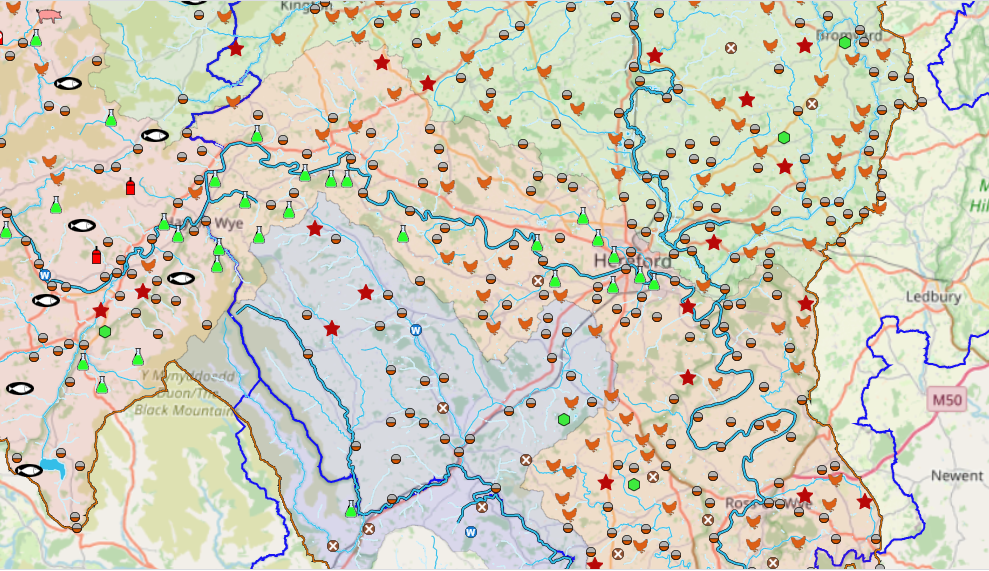
In 2021, we teamed up with the Brecon and Radnor branch of Campaign for the Protection of Rural Wales (CPRW) to produce an interactive layered map showing monitoring sites, pollution incidents and intensive poultry and pig units. (There’s a lot of data so it may take a few moments to upload!).