Home ❯ News ❯ Hedgerows ❯ National Hedgerows Week 2026: Celebrating living history in Herefordshire
National Hedgerows Week 2026: Celebrating living history in Herefordshire
By Angharad
4th May 2026
National Hedgerows Week (4–10 May 2026) is the UK’s annual celebration of its largest wildlife habitat: the network of hedgerows that stitches the countryside together. Coordinated by The Tree Council and the Hedgelink coalition, the week shines a light on why hedgerows matter, the threats they face, and the people working to bring them back. In Herefordshire, that work has a name: Hedgerow Heroes.
Why hedgerows matter
Britain has lost an estimated 118,000 miles of hedgerow since 1950, and yet hedgerows still support 82 red-listed conservation priority species. They store carbon, slow flooding, shelter livestock, give safe passage to hedgehogs and dormice, and connect fragmented habitats across our farmed landscape. In short, every metre matters, and Herefordshire has thousands of them.
Hedgerow Heroes: 9.38km this season
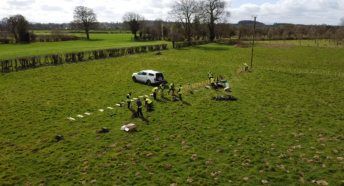
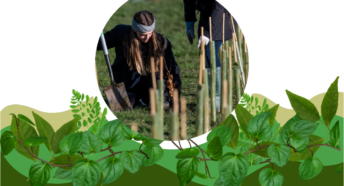
Our project planted and restored 9,377 metres of hedgerow across 18 farmland sites in Herefordshire between November 2025 and April 2026, more than twice our 4km season target. Around 50,000 native plants went in under biodegradable guards, supported by 226 volunteers giving 1,636 hours across 104 planting sessions, and 65 people trained in traditional hedgelaying. A huge thank you to everyone involved.
How to get involved this Hedgerows Week
Volunteer with Hedgerow Heroes for our autumn 2026 planting season. Click here to find out more.
Landowners talk to us about hedges on your land. Email info@cpreherefordshire.org.uk with details about a new hedge or gapping up of an existing hedgerow.
Schools and parishes host a planting day or contact us to arrange a talk about hedgerows by our Director Andrew McRobb.
Everyone visit The Tree Council and Hedgelink for free resources and let your nearest hedge grow thick this spring.
Watch: a brief history of British hedges
Hedgerows aren’t just biodiversity infrastructure, they’re living history. Some are over a thousand years old, marking parish boundaries and Anglo-Saxon estates. Sit back for nine minutes and enjoy this excellent history of British hedges:
After watching the film, our Chairman of Trustees, Tom, shared his own reflections:
This wonderful film recorded lovingly and in detail the long rural tradition of hedge management. But by chance it was made when hedges were on the brink of a huge change.
This rural craft stretched back into our Saxon history and before. There were many variations in how hedges were grown and managed across the country and in the design of traditional tools used to maintain them. Hedge lines in Cornwall and much of Devon were planted along the top of substantial earth and stone banks. In Dorset, a tradition developed of laying down great bundles of mature hedge plants and tying them down. In much of the Midlands and in Herefordshire, hedge plants were regularly laid down and woven together, through lines of stakes driven into the ground at an angle with a ‘barley sugar twist’ of flexible sappy ethering rods (often cut from hazel) to make the hedge tops rigid.
All of these approaches were very time-consuming. While hedges were the main means of containing livestock and while almost all farm work was by hand, this system made sense – indeed there was no alternative if hedges were to be kept stock proof.
The laying or plashing of hedges every fifteen to twenty years was done in sections every winter when the plants were dormant and the farm workers free from their spring and summer work. Trimming took place every year by hand, using hooks on long handles or staves to cut back the hedge line to a reasonably regular profile and reduce shading on the field edges.
When this excellent film was made, all this was about to change radically. The great movement of working people away from agriculture, delayed by the war and the work of the Women’s’ Land Army, was to resume at great speed. The availability of skilled labour needed to manage hedgerows declined very rapidly. The cost of agricultural pay rose significantly. Meanwhile, modern fencing, using cheap sawmill soft wood and modern wire became increasingly available and affordable.
The annual maintenance of hedges became increasingly expensive for farmers, and the cyclical skilled layers of hedges very difficult to find, let alone afford. There was a serious risk that hedges would be lost in vast quantities and lengths as farmers struggled to maintain economic viability and turned to cheap fencing. There was also the attraction of a big reduction in the area of land taken up with boundaries if hedges were removed and replaced with thin fence lines. It was said that ‘there had once been a time for hedge-laying in the winter – but now it is a time for hedge removal’.
This is where, rather surprisingly, modern technology came to the rescue in the form of the mechanical hedge trimmer. A few early horse-drawn hedge trimmers made little impact, but in 1948, the first tractor-mounted mechanical cutter was introduced at the Royal Agricultural Show. The innovation took a mechanical grass cutter bar and mounted it on an arm controlled by the tractor driver. The effect was rapid and transforming. A cost cycle calculation of up to 30 years showed fences were cheaper than hedges to maintain. But cheap mechanical trimming came to the rescue. By 1971, just 23 years later, there were 38,000 tractor-mounted cutters in operation. The hedgerow was saved – at least in part, by the ability of farmers to manage the annual trim with minimal labour and at a low cost in time in particular.
Alas, hedges were threatened by other economic forces – the reduction in the need for small fields, the increased scale of individual farm holdings, the economic attraction of larger units for growing crops in particular, and the land gain achieved by removing hedges altogether. While the annual problem had been solved by mechanical means, the long term role of hedges in farm management was threatened by big improvements in machinery used for mechanical clearance and the relative reduction in cost of ‘one off’ hedgerow removal. Huge losses of hedges ensued, not because of annual maintenance costs but because of the business case for removal.
In the mid-1960s hedges were being grubbed up at a rate of up to 8,000 miles each year, and removal speeded up again in the 1980s. It took CPRE along with others, to secure Hedgerow Regulations in 1997 which finally helped to reduce the ease with which most hedges could be removed. By then, of course, there were only half the hedges left to protect, and the great value of hedges had become far better understood. Many farmers had always known the value of – and attractiveness – of hedgerows and had kept them, relying on cheap mechanical trimming to keep them manageable.
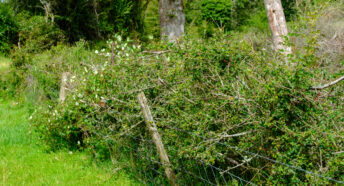
Hedges are still very vulnerable – not so much nowadays from physical removal, as from slow decline. If livestock are not kept away from an unlaid hedge, it only takes a few years for the hedge to be ‘grazed out’ at the bottom. And if trimming continues every year, eventually a line of aging stems, topped with a thin shelf of top growth, is all that is left.
To some extent, the revival of hedge-laying as a craft which pays well enough to earn a living and the introduction of grants paid for by the taxpayer, has helped reverse this decline. CPRE Herefordshire is taking this positive development to a new level, working with farmers to plant, replant and restore hedges across the county.



 Contact us
 Visit CPRE.org
 Donate